this question is like an onion. there are so many layers and you can peel away as many as you want but you're still looking at the same thing ultimately.
this is quite a tricky question because the question can be interpreted in a number of ways. also we should try to be realistic and practical, or at least have a common agreement to what we mean by response as in how much response do we consider responsive and what we mean by peak power as in how much more or less peak power in relation to which ballpark figure are we considering?
i think the easy answer would be a nice mix of both. surely too much response with too little peak power or too much peak power with no response whatsoever that you probably never hit the peak power rpm would both be bad.
if we take the stock car configuration as a benchmark, then it'd be good if we can have more response and also more peak power than stock. to me, its nice to have a car that is eager under part throttle conditions, ie every little step more on the throttle gives more torque, whatever the rpm. it would also be nice if the increments of torque is quite linear to throttle input, rather than say a setup where there is virtually no difference between 0-80%throttle, then suddenly in the last 20% of throttle the car shoots off like a rocket.
as for power, it would be nice to have a car that has more and more power as the revs build all the way to redline. ie there's a climax at the end, rather than a flat power delivery like that of the rx8, it just revs and revs but never reaches a peak(i borrow this from nick aka gti88 ;) ).
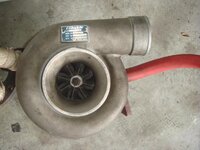
also by response do we mean the rpm that the turbo begins to make useful boost, or the true response of the turbo once there is sufficient revs to boil it. i have mentioned this in the past.
say we have 2 turbos. both on a 4g63. one is the original td05 16g, and the other one is a hks gt2835. on the same engine, we set the boost limit at 1bar for both. on the td05 16g, it hits 1bar by 3000rpm and the car really pulls. with the gt2835, it only hits 1bar at 4000rpm. in both cases we start the test in 5th gear at 2000rpm and floor the throttle.
so on this account the td05 16g has better response. now we go and do another test. we accelerate in 5th gear to 5500rpm, then back off throttle completely. when the revs drop to 4500rpm, we suddenly whack full throttle and using an ecu with a datalogger, go back to see at 4500rpm when you suddenly stab the throttle, what was the time taken for the td05 16g and gt2835 to hit 1bar.
we then repeat this test from say 10% throttle at 4500rpm and immediately throttle to 80% and log the time it takes each turbo to hit 1bar.
now, i might be completely wrong here. the 16g is a smaller and lighter wheel. but i suspect, i stress here, suspect, the gt2835 will have better times shown on the data logger. of course if we did the test a bit differently at different rpms and/or different throttle settings and/or boost the results will be different. but to me, this is what i mean by response. once you get going, how fast the turbo reacts to your inputs. response to me is not so simple as turbo lag rpm. after all, if you're a car nut, you should drive with more enthusiasm and downshift if you really need to get going so rpm turbo lag shouldn't really be such a problem.
oh but to answer the question, of course response! this is a street car man!! :D