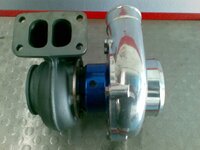
A turbocharger is an exhaust gas driven compressor used in internal-combustion engines to increase the power output of the engine by increasing the mass of oxygen entering the engine. A key advantage of turbochargers is that they offer a considerable increase in engine power with only a slight increase in weight.
http://img372.imageshack.us/img372/4552/turbocharger2ag.jpg
A disadvantage in gasoline engines is that the compression ratio should be lowered (so as not to exceed maximum compression pressure and to prevent engine knocking) which reduces engine efficiency when operating at low power. This disadvantage does not apply to specifically designed turbocharged diesel engines. However, for operation at altitude, the power recovery of a turbocharger makes a big difference to total power output of both engine types. This last factor makes turbocharging aircraft engines considerably advantageous—and was the original reason for development of the device.
Principle of operation
A turbocharger is an exhaust gas driven supercharger. All superchargers have a gas compressor in the intake tract of the engine which compresses the intake air above atmospheric pressure, greatly increasing the volumetric efficiency beyond that of naturally-aspirated engines. A turbocharger also has a turbine that powers the compressor using wasted energy from the exhaust gases. Compressor and turbine have the same shaft, similar to a turbojet aircraft engine.
The term supercharger is very often used when referring to a mechanically driven turbocharger, which is most often driven from the engine's crankshaft by means of a belt (otherwise, and in many aircraft engines, by a geartrain), whereas a turbocharger is exhaust-driven, the name turbocharger being a contraction of the earlier "turbine-supercharger". Because the turbine of a turbocharger is in-itself a heat engine, a turbocharger equipped engine will normally compress the intake air more efficiently than a mechanical supercharger. But because of "turbo lag" (see below), engines with mechanical superchargers are typically more responsive.
The compressor increases the pressure of the air entering the engine, so a greater mass of oxygen enters the combustion chamber in the same time interval (an increase in fuel is required to keep the mixture the same air to fuel ratio). This greatly improves the volumetric efficiency of the engine, and thereby creates more power. The additional fuel is provided by the proper tuning of the fuel injectors or carburetor.
The increase in pressure is called "boost" and is measured in pascals, bars or lbf/in². The energy from the extra fuel leads to more overall engine power. For example, at 100% efficiency a turbocharger providing 101 kPa (14.7 lbf/in²) of boost would effectively double the amount of air entering the engine because the total pressure is twice atmospheric pressure. However, there are some parasitic losses due to heat and exhaust backpressure from the turbine, so turbochargers are generally only about 80% efficient, at peak efficiency, because it takes some work for the engine to push those gases through the turbocharger turbine (which is acting as a restriction in the exhaust) and the now-compressed intake air has been heated, reducing its density.
For automobile use, typical boost pressure is in the general area of 80 kPa (11.6 lbf/in²), but it can be much more. Because it is a centrifugal pump, a typical turbocharger, depending on design, will only start to deliver boost from a certain rpm where the engine starts producing enough exhaust gas to spin the turbocharger fast enough to make pressure. This engine rpm is referred to as the boost threshold.
A main disadvantage of high boost pressures for internal combustion engines is that compressing the inlet air increases its temperature. This increase in charge temperature is a limiting factor for petrol engines that can only tolerate a limited increase in charge temperature before detonation occurs. The higher temperature is a volumetric efficiency downgrade for both types of engine. The pumping-effect heating can be alleviated by aftercooling (sometimes called intercooling).
Design details
When a gas is compressed, its temperature rises. It is not uncommon for a turbocharger to be pushing out air that is 90 °C (200°F). Compressed air from a turbo may be (and most commonly is, on petrol engines) cooled before it is fed into the cylinders, using an intercooler or a charge air cooler (a heat-exchange device).
A turbo spins very fast, most peak between 80,000 and 150,000 rpm depending on size (using low inertia turbos, 190,000 rpm), weight of the rotating parts, boost pressure developed and compressor design. Such high rotation speeds would cause problems for standard ball bearings leading to failure so most turbo-chargers use fluid bearings. These feature a flowing layer of oil that suspends and cools the moving parts. The oil is usually taken from the engine-oil circuit and usually needs to be cooled by an oil cooler before it circulates through the engine. Some turbochargers use incredibly precise ball bearings that offer less friction than a fluid bearing but these are also suspended in fluid-dampened cavities. Lower friction means the turbo shaft can be made of lighter materials, reducing so-called turbo lag or boost lag. Some car makers use water cooled turbochargers for added bearing life.
Turbochargers with foil bearings are in development which eliminates the need for bearing cooling or oil delivery systems.
To manage the upper-deck air pressure the turbocharger's exhaust gas flow is regulated with a wastegate that bypasses excess exhaust gas entering the turbocharger's turbine. This regulates the rotational speed of the turbine and the output of the compressor. The wastegate is opened and closed by the compressed air from turbo (the upper-deck pressure) and can be raised by using a solenoid to regulate the pressure fed to the wastegate membrane. This solenoid can be controlled by Automatic Performance Control, the engine's electronic control unit or an after market boost control computer. Another method of raising the boost pressure is through the use of check and bleed valves to keep the pressure at the membrane lower than the pressure in the system.
Some turbochargers utilise a set of vanes in the exhaust housing to maintain a constant gas velocity across the turbine, the same kind of control as used on power plant turbines. These turbochargers have minimal amount of lag, have a low boost threshold, and are very efficient at higher engine speeds. In many setups these turbos don't even need a wastegate. The vanes are controlled by a membrane identical to the one on a wastegate but the level of control required is a bit different. The first car manufacturer to use these turbos was the limited-production 1989 Shelby CSX-VNT. It utilised a turbo from Garrett, called the VNT-25 because it uses the same compressor and shaft as the more common Garrett T-25. This type of turbine is called Variable Nozzle Turbine (VNT). Turbocharger manufacturer Aerocharger use the term 'Variable Area Turbine Nozzle' (VATN) to describe this type of turbine nozzle.
Reliability
As long as the oil supply is clean and the exhaust gas does not become overheated (lean mixtures or retarded spark timing on a gasoline engine) a turbocharger can be very reliable but care of the unit is important. Replacing a turbo that lets go and sheds its blades will be expensive. The use of synthetic oils is recommended in turbo engines.
After high speed operation of the engine it is important to let the engine run at idle speed for one to three minutes before turning off the engine. Saab, in its owner manuals, recommends a period of just 30 seconds. This lets the turbo rotating assembly cool from the lower exhaust gas temperatures. Not doing this will also result in the critical oil supply to the turbocharger being severed when the engine stops while the turbine housing and exhaust manifold are still very hot, leading to coking (burning) of the lubricating oil trapped in the unit when the heat soaks into the bearings and later, failure of the supply of oil when the engine is next started causing rapid bearing wear and failure. Even small particles of burnt oil will accumulate and lead to choking the oil supply and failure. A turbo timer is a device designed to keep an automotive engine running for a pre-specified period of time, in order to execute this cool-down period automatically. Turbos with watercooled bearing cartridges have a protective barrier against cooking. The water boils in the cartridge when the engine is shut off and forms a natural recirculation to drain away the heat. It is still a good idea to not shut the engine off while the turbo and manifold are still glowing. In custom applications utilising tubular headers rather than cast iron manifolds, the need for a cooldown period is reduced because the lighter headers store much less heat than heavy cast iron manifolds.
Diesel engines are usually much kinder to turbos because their exhaust gas temperature is much lower than that of gasoline engines and because most operators allow the engine to idle and do not switch it off immediately after heavy use.
Lag
A lag is sometimes felt by the driver of a turbocharged vehicle as a delay between pushing on the accelerator pedal and feeling the turbo kick-in. This is symptomatic of the time taken for the exhaust system driving the turbine to come to high pressure and for the turbine rotor to overcome its rotational inertia and reach the speed necessary to supply boost pressure. The directly-driven compressor in a supercharger does not suffer this problem. Conversely on light loads or at low rpm a turbocharger supplies less boost and the engine is more efficient than a supercharged engine.
Lag can be reduced by lowering the rotational inertia of the turbine, for example by using lighter parts to allow the spin-up to happen more quickly. Ceramic turbines are a big help in this direction. Unfortunately, their relative fragility limits the maximum boost they can supply. Another way to reduce lag is to change the aspect ratio of the turbine by reducing the diameter and increasing the gas-flow path-length. Increasing the upper-deck air pressure and improving the wastegate response help but there are cost increases and reliability disadvantages that car manufacturers are not happy about. Lag is also reduced by using a precision bearing rather than a fluid bearing, this reduces friction rather than rotational inertia but contributes to faster acceleration of the turbo's rotating assembly.
Another common method of equalizing turbo lag, is to have the turbine wheel "clipped", or to reduce the surface area of the turbine wheel's rotating blades. By clipping a minute portion off the tip of each blade of the turbine wheel, less restriction is imposed upon the escaping exhaust gases. This imparts less impedance onto the flow of exhaust gasses at low rpm, allowing the vehicle to retain more of its low-end torque, but also pushes the effective boost rpm to a slightly higher level. The amount a turbine wheel is and can be clipped is highly application-specific. Turbine clipping is measured and specified in degrees.
Other setups, most notably in V-type engines, utilize two identically-sized but smaller turbos, each fed by a separate set of exhaust streams from the engine. The two smaller turbos produce the same (or more) aggregate amount of boost as a larger single turbo, but since they are smaller they reach their optimal rpm, and thus optimal boost delivery, faster. Such an arrangement of turbos is typically referred to as a "twin turbo" setup.
Some car makers combat lag by using two small turbos (like Toyota, Subaru, Maserati, Mazda, and Audi). A typical arrangement for this is to have one turbo active across the entire rev range of the engine and one coming on-line at higher rpm. Early designs would have one turbocharger active up to a certain rpm, after which both turbochargers are active. Below this rpm, both exhaust and air inlet of the secondary turbo are closed . Being individually smaller they do not suffer from excessive lag and having the second turbo operating at a higher rpm range allows it to get to full rotational speed before it is required. Such combinations are referred to as "sequential turbos". Sequential turbochargers are usually much more complicated than single or twin-turbocharger systems because they require what amount to three sets of pipes-intake and wastegate pipes for the two turbochargers as well as valves to control the direction of the exhaust gases. An example of this is the current BMW E60 5-Series 535d.
Lag is not to be confused with the boost threshold, however many publications still make this basic mistake. The boost threshold of a turbo system describes the minimum turbo rpm at which the turbo is physically able to supply the requested boost level. Newer turbocharger and engine developments have caused boost thresholds to steadily decline to where day-to-day use feels perfectly natural. Putting your foot down at 1200 engine rpm and having no boost until 2000 engine rpm is an example of boost threshold and not lag.
Race cars often utilise anti-lag to completely eliminate lag at the cost of reduced turbocharger life.
On Modern hi-tech diesel engines, this problem is virtualy eliminated by utilising a variable geometry turbocharger.
Boost
Boost refers to the increased manifold pressure that is generated by the intake side turbine. This is limited to keep the turbo inside its design operating range by controlling the wastegate which shunts the exhaust gasses away from the exhaust side turbine. Many diesel engines do not have any wastegate because the amount of exhaust energy is controlled directly by the amount of fuel injected into the engine, and slight variations in boost pressure do not make a difference for the engine.
Applications
Turbocharging is very common on Diesel engines in conventional automobiles, in trucks, for marine and heavy machinery applications. In fact, for current automotive applications, non-turbocharged diesel engines are becoming increasingly rare. Diesels are particularly suitable for turbocharging for several reasons:
Naturally-aspirated diesels have lower power-to-weight ratios compared to gasoline engines, turbocharging will improve this P:W ratio.
Diesel engines require more robust construction because they already run at very high compression ratio and at high temperatures so they generally require little additional reinforcement to be able to cope with the addition of the turbocharger. Gasoline engines often require extensive modification for turbocharging.
Diesel engines have a narrower band of engine speeds at which they operate, thus making the operating characteristics of the turbocharger over that "rev range" less of a compromise than on a gasoline-powered engine.
Diesel engines blow nothing but air into the cylinders during cylinder charging, squirting fuel into the cylinder only after the intake valve has closed and compression has begun. Gasoline/petrol engines differ from this in that both fuel and air are introduced during the intake cycle and both are compressed during the compression cycle. The higher intake charge temperatures of forced-induction engines reduces the amount of compression that is possible with a gasoline/petrol engine, whereas diesel engines are far less sensitive to this.
The first production turbocharged engines came from General Motors. The A-body Oldsmobile Cutlass and Chevrolet Corvair were both fitted with turbochargers in 1962. The Oldsmobile is often recognized as the first, since it came out a few months earlier than the Corvair. Its Turbo Jetfire was a 215 in³ (3.5 L) V8, while the Corvair engine was a 140 in³ (2.3 L) flat-6. Both of these engines were abandoned within a few years, and GM's next turbo engine came more than two decades later.
Today, turbocharging is most commonly used on two types of engines: Gasoline engines in high-performance automobiles and Diesel engines in work trucks. Small cars in particular benefit from this technology, as there is often little room to fit a larger-output (and physically larger) engine. Saab has been the leading car maker using turbo chargers in production cars, starting with the 1978 Saab 99. The Porsche 944 utilized a turbo unit in the 944 Turbo (Porsche internal model number 951), to great advantage, bringing its 0-100 speeds very close to its contemporary non-turbo big brother, the Porsche 928. Contemporary examples of turbocharged performance cars include the Dodge Neon SRT-4, Subaru Impreza WRX, Mazda RX-7, Mitsubishi Lancer Evolution, and the Porsche 911 Turbo.
In Formula 1, in the so called "Turbo Era", engines with a capacity of 1500cc could achieve anywhere from 1000 to 1500hp (746 to 1119 kW) (Renault, Honda, BMW). Renault was the first manufacturer to apply turbo technology in the F1 field, in 1977. The project's high cost was compensated for by its performance, and led to other engine manufacturers following suit. The Turbo-charged engines took over the F1 field and ended the Ford Cosworth DFV era in the mid-80s.
Small car turbos are increasingly being used as the basis for small jet engines used for flying model aircraft—though the conversion is a highly specialised job—one not without its dangers.
Turbochargers were first used on aircraft in the 1930s prior to World War II. The primary purpose behind most aircraft-based applications was to increase the altitude at which the airplane can fly, by compensating for the lower atmospheric pressure present at high altitude. Aircraft such as the Lockheed P-38 Lightning, Boeing B-17 Flying Fortress and B-29 Superfortress all used exhaust driven "turbo-superchargers" to increase high altitude engine power.
Most modern turbocharged aircraft use an adjustable wastegate. The wastegate is controlled manually, or by a pneumatic/hydraulic control system, or, as is becoming more and more common, by a flight computer. In the interests of engine longevity, the wastegate is usually kept open, or nearly so, at sea-level to keep from overboosting the engine. As the aircraft climbs, the wastegate is gradually closed, maintaining the manifold pressure at or above sea-level. In aftermarket applications, aircraft turbochargers sometimes do not overboost the engine, but rather compress ambient air to sea-level pressure. For this reason, such aircraft are sometimes refered to as being turbo-normalised. Most applications produced by the major manufacturers (Beech, Cessna, Piper and others) increase the maximum engine intake air pressure by as much as 35%. Special attention to engine cooling and component strength is required because of the increased combustion heat and power.
Turbo-Alterator is a form of turbocharger that generates electricity instead of boosting engine's air flow. On 2005/9/21, Foresight Vehicle announced the first known implementation of such unit for automobiles, under the name TIGERS (Turbo-generator Integrated Gas Energy Recovery System).
http://img372.imageshack.us/img372/4552/turbocharger2ag.jpg
A disadvantage in gasoline engines is that the compression ratio should be lowered (so as not to exceed maximum compression pressure and to prevent engine knocking) which reduces engine efficiency when operating at low power. This disadvantage does not apply to specifically designed turbocharged diesel engines. However, for operation at altitude, the power recovery of a turbocharger makes a big difference to total power output of both engine types. This last factor makes turbocharging aircraft engines considerably advantageous—and was the original reason for development of the device.
Principle of operation
A turbocharger is an exhaust gas driven supercharger. All superchargers have a gas compressor in the intake tract of the engine which compresses the intake air above atmospheric pressure, greatly increasing the volumetric efficiency beyond that of naturally-aspirated engines. A turbocharger also has a turbine that powers the compressor using wasted energy from the exhaust gases. Compressor and turbine have the same shaft, similar to a turbojet aircraft engine.
The term supercharger is very often used when referring to a mechanically driven turbocharger, which is most often driven from the engine's crankshaft by means of a belt (otherwise, and in many aircraft engines, by a geartrain), whereas a turbocharger is exhaust-driven, the name turbocharger being a contraction of the earlier "turbine-supercharger". Because the turbine of a turbocharger is in-itself a heat engine, a turbocharger equipped engine will normally compress the intake air more efficiently than a mechanical supercharger. But because of "turbo lag" (see below), engines with mechanical superchargers are typically more responsive.
The compressor increases the pressure of the air entering the engine, so a greater mass of oxygen enters the combustion chamber in the same time interval (an increase in fuel is required to keep the mixture the same air to fuel ratio). This greatly improves the volumetric efficiency of the engine, and thereby creates more power. The additional fuel is provided by the proper tuning of the fuel injectors or carburetor.
The increase in pressure is called "boost" and is measured in pascals, bars or lbf/in². The energy from the extra fuel leads to more overall engine power. For example, at 100% efficiency a turbocharger providing 101 kPa (14.7 lbf/in²) of boost would effectively double the amount of air entering the engine because the total pressure is twice atmospheric pressure. However, there are some parasitic losses due to heat and exhaust backpressure from the turbine, so turbochargers are generally only about 80% efficient, at peak efficiency, because it takes some work for the engine to push those gases through the turbocharger turbine (which is acting as a restriction in the exhaust) and the now-compressed intake air has been heated, reducing its density.
For automobile use, typical boost pressure is in the general area of 80 kPa (11.6 lbf/in²), but it can be much more. Because it is a centrifugal pump, a typical turbocharger, depending on design, will only start to deliver boost from a certain rpm where the engine starts producing enough exhaust gas to spin the turbocharger fast enough to make pressure. This engine rpm is referred to as the boost threshold.
A main disadvantage of high boost pressures for internal combustion engines is that compressing the inlet air increases its temperature. This increase in charge temperature is a limiting factor for petrol engines that can only tolerate a limited increase in charge temperature before detonation occurs. The higher temperature is a volumetric efficiency downgrade for both types of engine. The pumping-effect heating can be alleviated by aftercooling (sometimes called intercooling).
Design details
When a gas is compressed, its temperature rises. It is not uncommon for a turbocharger to be pushing out air that is 90 °C (200°F). Compressed air from a turbo may be (and most commonly is, on petrol engines) cooled before it is fed into the cylinders, using an intercooler or a charge air cooler (a heat-exchange device).
A turbo spins very fast, most peak between 80,000 and 150,000 rpm depending on size (using low inertia turbos, 190,000 rpm), weight of the rotating parts, boost pressure developed and compressor design. Such high rotation speeds would cause problems for standard ball bearings leading to failure so most turbo-chargers use fluid bearings. These feature a flowing layer of oil that suspends and cools the moving parts. The oil is usually taken from the engine-oil circuit and usually needs to be cooled by an oil cooler before it circulates through the engine. Some turbochargers use incredibly precise ball bearings that offer less friction than a fluid bearing but these are also suspended in fluid-dampened cavities. Lower friction means the turbo shaft can be made of lighter materials, reducing so-called turbo lag or boost lag. Some car makers use water cooled turbochargers for added bearing life.
Turbochargers with foil bearings are in development which eliminates the need for bearing cooling or oil delivery systems.
To manage the upper-deck air pressure the turbocharger's exhaust gas flow is regulated with a wastegate that bypasses excess exhaust gas entering the turbocharger's turbine. This regulates the rotational speed of the turbine and the output of the compressor. The wastegate is opened and closed by the compressed air from turbo (the upper-deck pressure) and can be raised by using a solenoid to regulate the pressure fed to the wastegate membrane. This solenoid can be controlled by Automatic Performance Control, the engine's electronic control unit or an after market boost control computer. Another method of raising the boost pressure is through the use of check and bleed valves to keep the pressure at the membrane lower than the pressure in the system.
Some turbochargers utilise a set of vanes in the exhaust housing to maintain a constant gas velocity across the turbine, the same kind of control as used on power plant turbines. These turbochargers have minimal amount of lag, have a low boost threshold, and are very efficient at higher engine speeds. In many setups these turbos don't even need a wastegate. The vanes are controlled by a membrane identical to the one on a wastegate but the level of control required is a bit different. The first car manufacturer to use these turbos was the limited-production 1989 Shelby CSX-VNT. It utilised a turbo from Garrett, called the VNT-25 because it uses the same compressor and shaft as the more common Garrett T-25. This type of turbine is called Variable Nozzle Turbine (VNT). Turbocharger manufacturer Aerocharger use the term 'Variable Area Turbine Nozzle' (VATN) to describe this type of turbine nozzle.
Reliability
As long as the oil supply is clean and the exhaust gas does not become overheated (lean mixtures or retarded spark timing on a gasoline engine) a turbocharger can be very reliable but care of the unit is important. Replacing a turbo that lets go and sheds its blades will be expensive. The use of synthetic oils is recommended in turbo engines.
After high speed operation of the engine it is important to let the engine run at idle speed for one to three minutes before turning off the engine. Saab, in its owner manuals, recommends a period of just 30 seconds. This lets the turbo rotating assembly cool from the lower exhaust gas temperatures. Not doing this will also result in the critical oil supply to the turbocharger being severed when the engine stops while the turbine housing and exhaust manifold are still very hot, leading to coking (burning) of the lubricating oil trapped in the unit when the heat soaks into the bearings and later, failure of the supply of oil when the engine is next started causing rapid bearing wear and failure. Even small particles of burnt oil will accumulate and lead to choking the oil supply and failure. A turbo timer is a device designed to keep an automotive engine running for a pre-specified period of time, in order to execute this cool-down period automatically. Turbos with watercooled bearing cartridges have a protective barrier against cooking. The water boils in the cartridge when the engine is shut off and forms a natural recirculation to drain away the heat. It is still a good idea to not shut the engine off while the turbo and manifold are still glowing. In custom applications utilising tubular headers rather than cast iron manifolds, the need for a cooldown period is reduced because the lighter headers store much less heat than heavy cast iron manifolds.
Diesel engines are usually much kinder to turbos because their exhaust gas temperature is much lower than that of gasoline engines and because most operators allow the engine to idle and do not switch it off immediately after heavy use.
Lag
A lag is sometimes felt by the driver of a turbocharged vehicle as a delay between pushing on the accelerator pedal and feeling the turbo kick-in. This is symptomatic of the time taken for the exhaust system driving the turbine to come to high pressure and for the turbine rotor to overcome its rotational inertia and reach the speed necessary to supply boost pressure. The directly-driven compressor in a supercharger does not suffer this problem. Conversely on light loads or at low rpm a turbocharger supplies less boost and the engine is more efficient than a supercharged engine.
Lag can be reduced by lowering the rotational inertia of the turbine, for example by using lighter parts to allow the spin-up to happen more quickly. Ceramic turbines are a big help in this direction. Unfortunately, their relative fragility limits the maximum boost they can supply. Another way to reduce lag is to change the aspect ratio of the turbine by reducing the diameter and increasing the gas-flow path-length. Increasing the upper-deck air pressure and improving the wastegate response help but there are cost increases and reliability disadvantages that car manufacturers are not happy about. Lag is also reduced by using a precision bearing rather than a fluid bearing, this reduces friction rather than rotational inertia but contributes to faster acceleration of the turbo's rotating assembly.
Another common method of equalizing turbo lag, is to have the turbine wheel "clipped", or to reduce the surface area of the turbine wheel's rotating blades. By clipping a minute portion off the tip of each blade of the turbine wheel, less restriction is imposed upon the escaping exhaust gases. This imparts less impedance onto the flow of exhaust gasses at low rpm, allowing the vehicle to retain more of its low-end torque, but also pushes the effective boost rpm to a slightly higher level. The amount a turbine wheel is and can be clipped is highly application-specific. Turbine clipping is measured and specified in degrees.
Other setups, most notably in V-type engines, utilize two identically-sized but smaller turbos, each fed by a separate set of exhaust streams from the engine. The two smaller turbos produce the same (or more) aggregate amount of boost as a larger single turbo, but since they are smaller they reach their optimal rpm, and thus optimal boost delivery, faster. Such an arrangement of turbos is typically referred to as a "twin turbo" setup.
Some car makers combat lag by using two small turbos (like Toyota, Subaru, Maserati, Mazda, and Audi). A typical arrangement for this is to have one turbo active across the entire rev range of the engine and one coming on-line at higher rpm. Early designs would have one turbocharger active up to a certain rpm, after which both turbochargers are active. Below this rpm, both exhaust and air inlet of the secondary turbo are closed . Being individually smaller they do not suffer from excessive lag and having the second turbo operating at a higher rpm range allows it to get to full rotational speed before it is required. Such combinations are referred to as "sequential turbos". Sequential turbochargers are usually much more complicated than single or twin-turbocharger systems because they require what amount to three sets of pipes-intake and wastegate pipes for the two turbochargers as well as valves to control the direction of the exhaust gases. An example of this is the current BMW E60 5-Series 535d.
Lag is not to be confused with the boost threshold, however many publications still make this basic mistake. The boost threshold of a turbo system describes the minimum turbo rpm at which the turbo is physically able to supply the requested boost level. Newer turbocharger and engine developments have caused boost thresholds to steadily decline to where day-to-day use feels perfectly natural. Putting your foot down at 1200 engine rpm and having no boost until 2000 engine rpm is an example of boost threshold and not lag.
Race cars often utilise anti-lag to completely eliminate lag at the cost of reduced turbocharger life.
On Modern hi-tech diesel engines, this problem is virtualy eliminated by utilising a variable geometry turbocharger.
Boost
Boost refers to the increased manifold pressure that is generated by the intake side turbine. This is limited to keep the turbo inside its design operating range by controlling the wastegate which shunts the exhaust gasses away from the exhaust side turbine. Many diesel engines do not have any wastegate because the amount of exhaust energy is controlled directly by the amount of fuel injected into the engine, and slight variations in boost pressure do not make a difference for the engine.
Applications
Turbocharging is very common on Diesel engines in conventional automobiles, in trucks, for marine and heavy machinery applications. In fact, for current automotive applications, non-turbocharged diesel engines are becoming increasingly rare. Diesels are particularly suitable for turbocharging for several reasons:
Naturally-aspirated diesels have lower power-to-weight ratios compared to gasoline engines, turbocharging will improve this P:W ratio.
Diesel engines require more robust construction because they already run at very high compression ratio and at high temperatures so they generally require little additional reinforcement to be able to cope with the addition of the turbocharger. Gasoline engines often require extensive modification for turbocharging.
Diesel engines have a narrower band of engine speeds at which they operate, thus making the operating characteristics of the turbocharger over that "rev range" less of a compromise than on a gasoline-powered engine.
Diesel engines blow nothing but air into the cylinders during cylinder charging, squirting fuel into the cylinder only after the intake valve has closed and compression has begun. Gasoline/petrol engines differ from this in that both fuel and air are introduced during the intake cycle and both are compressed during the compression cycle. The higher intake charge temperatures of forced-induction engines reduces the amount of compression that is possible with a gasoline/petrol engine, whereas diesel engines are far less sensitive to this.
The first production turbocharged engines came from General Motors. The A-body Oldsmobile Cutlass and Chevrolet Corvair were both fitted with turbochargers in 1962. The Oldsmobile is often recognized as the first, since it came out a few months earlier than the Corvair. Its Turbo Jetfire was a 215 in³ (3.5 L) V8, while the Corvair engine was a 140 in³ (2.3 L) flat-6. Both of these engines were abandoned within a few years, and GM's next turbo engine came more than two decades later.
Today, turbocharging is most commonly used on two types of engines: Gasoline engines in high-performance automobiles and Diesel engines in work trucks. Small cars in particular benefit from this technology, as there is often little room to fit a larger-output (and physically larger) engine. Saab has been the leading car maker using turbo chargers in production cars, starting with the 1978 Saab 99. The Porsche 944 utilized a turbo unit in the 944 Turbo (Porsche internal model number 951), to great advantage, bringing its 0-100 speeds very close to its contemporary non-turbo big brother, the Porsche 928. Contemporary examples of turbocharged performance cars include the Dodge Neon SRT-4, Subaru Impreza WRX, Mazda RX-7, Mitsubishi Lancer Evolution, and the Porsche 911 Turbo.
In Formula 1, in the so called "Turbo Era", engines with a capacity of 1500cc could achieve anywhere from 1000 to 1500hp (746 to 1119 kW) (Renault, Honda, BMW). Renault was the first manufacturer to apply turbo technology in the F1 field, in 1977. The project's high cost was compensated for by its performance, and led to other engine manufacturers following suit. The Turbo-charged engines took over the F1 field and ended the Ford Cosworth DFV era in the mid-80s.
Small car turbos are increasingly being used as the basis for small jet engines used for flying model aircraft—though the conversion is a highly specialised job—one not without its dangers.
Turbochargers were first used on aircraft in the 1930s prior to World War II. The primary purpose behind most aircraft-based applications was to increase the altitude at which the airplane can fly, by compensating for the lower atmospheric pressure present at high altitude. Aircraft such as the Lockheed P-38 Lightning, Boeing B-17 Flying Fortress and B-29 Superfortress all used exhaust driven "turbo-superchargers" to increase high altitude engine power.
Most modern turbocharged aircraft use an adjustable wastegate. The wastegate is controlled manually, or by a pneumatic/hydraulic control system, or, as is becoming more and more common, by a flight computer. In the interests of engine longevity, the wastegate is usually kept open, or nearly so, at sea-level to keep from overboosting the engine. As the aircraft climbs, the wastegate is gradually closed, maintaining the manifold pressure at or above sea-level. In aftermarket applications, aircraft turbochargers sometimes do not overboost the engine, but rather compress ambient air to sea-level pressure. For this reason, such aircraft are sometimes refered to as being turbo-normalised. Most applications produced by the major manufacturers (Beech, Cessna, Piper and others) increase the maximum engine intake air pressure by as much as 35%. Special attention to engine cooling and component strength is required because of the increased combustion heat and power.
Turbo-Alterator is a form of turbocharger that generates electricity instead of boosting engine's air flow. On 2005/9/21, Foresight Vehicle announced the first known implementation of such unit for automobiles, under the name TIGERS (Turbo-generator Integrated Gas Energy Recovery System).
Last edited: