FAQs extracted from http://www.rustevader.com
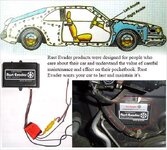
RUST EVADER ELECTRONIC CORROISON CONTROL DEVICE EVERYTHING YOU NEED TO KNOW
Will it drain my battery?
No, our Electronic Corrosion Control Device draws 23 milliamps which represents less current than the clock in the car uses.
Will it interfere with my radio?
No, our Electronic Corrosion Control Device creates no static discharge.
Will it affect my burglar alarm?
No. The small amount of current used to operate our Electronic Corrosion Control Device will not interfere
with any burglar alarm, OEM or aftermarket.
Do you need any special tools?
No. Just a pair of pliers and a wrench is sufficient.
How long does it takes to install?
Approximately 20 minutes for beginners.
How much current does it draw?
23 milliamps, at peak draw.
Will the heat from the engine affect the unit?
Our Electronic Corrosion Control Device will withstand temperature in excess of 500 degrees Fahrenheit however, caution should be observed so as not to attach the unit within twelve (12) inches of a turbocharger or manifold.
Do I put the anode on bare metal?
No. This would cause a direct short to the unit. our Electronic Corrosion Control Device system is not a
cathodic device so the anode must be attached to a painted metal surface.
How far apart do I place the anodes?
For optimum performance, the anodes should be attached a minimum of 48 surface inches apart.
Will it affect the computer system of the car?
No. Once again, a 23 milliamps draw, connected directly to the battery will not affect any on board computer systems.
Will it be harmful to human beings? Will it cause a shock?
No. our Electronic Corrosion Control Device will not affect human beings and will not cause a shock
How long has it been in use?
our Electronic Corrosion Control Device was developed over 20 years ago.
Is it a patented process?
Yes, there are currently four U.S. Patents issued on our Electronic Corrosion Control Device.
Where do I place the anodes on a truck or van?
The anodes should be placed one in front under the hood and the second anode should be placed on the rear portion of the bed of a pick-up or the rear inside portion of a car.
How many have been sold?
As of January 2005 January, there have been just under 1 million of our Electronic Corrosion Control Device units sold.
Has any testing been conducted on our Electronic Corrosion Control Device?
Yes, our Electronic Corrosion Control Device has been tested by 18 independent laboratories through-out the world. It has been tested by the United States Testing Co., in New Jersey the Singapore Institute of Science and Research; Lada Samara in Russia; a 7 and a half year field test was successfully completed by WRTA radio, an independent news agency; PIMOT in Poland, a corrosion Laboratory in Hungary; a Performance Confirmation test was performed by Kovelco Research, Inc. In Japan and most recently the German TUV tested and approved of the device with endorsement of a CE stamp.
Will it affect my pacemaker?
No. One again, the small amount of current used will not in any way adversely affect pace akers.
Are there any serviceable parts?
No. In the event of premature failure, during the warranty period, simply remove the unit and return it to us for prompt replacement.
Do the anodes have to be replaced?
No. The anodes are not sacrificial and need not be replaced. However, in transferring our Electronic Corrosion Control Device unit to second vehicle, anodes could be damaged; therefore, a new anode kit may be purchased for the new installation.
What is the life expectancy of the unit?
The life expectancy of our Electronic Corrosion Control Device has been tested to function for a period of 15 years.
How does it works?
Our Electronic Corrosion Control Device Technology is based on capacitance. A small amount of current is
drawn every 8 to 10 seconds from the battery and through the ground side, additional electrons are passed onto all the painted metal body panels. These electrons remain trapped under the paint and remain there until there is an area where the paint has been removed i.e., stone chips, scratches. At this time, the additional free source of electrons escape to satisfy oxygen’s desire to couple with these electrons, thus dramatically reducing the corrosion process.
Is it just for use on motor vehicles?
Yes. our Electronic Corrosion Control Device was specifically designed for use on motor vehicles; however, other uses are also being explored.
Is it only sold in the USA?
No. our Electronic Corrosion Control Device is sold to 30 countries throughout the world.
Is it transferable to my next car?
Yes. our Electronic Corrosion Control Device can be removed and transferred from one vehicle to another. There is a good possibility that the anodes would be damaged; therefore, an anode kit can be purchased separately.
Does it interfere with the auto manufacturer’s warranty?
Provided the system is installed properly, there is no danger of any interference with the auto manufacturer’s warranty.
Why is it better than chemical rustproofing?
our Electronic Corrosion Control Device is more effective than chemical applications because electronically
the entire auto is protected not only from the inside, but also from the outside surface.
Why is it necessary on new cars?
Although auto manufacturers are making cars much better, rust still occurs. Since the automobile will be your second largest investment, it pays to protect it.
How effective is it on older vehicle?
Our Electronic Corrosion Control Device will effectively operate on all vehicles manufactured from 1977 to present. However, the condition of the used vehicle at the time of installation will dictate the quality of protection provided.
Is it effective on my used car?
Please refer to number 30 reply to this question.
What parts will it protect?
our Electronic Corrosion Control Device will effectively protect all painted body panels that have a negative ground, which in essence, means all the body panels of all vehicles.
How do I know it is working?
Proper operation is indicated by a red light which is on all the time and every 8 to 10 second the green LED lights on the module and anodes will flash very quickly.
How often do I have to check the unit?
It would be advisable to visually check for proper operation at any time the hood is raised for inspection of oil or coolant levels.
Should I connect the unit directly to the battery?
Yes. It is required that the unit be connected directly to the battery to eliminate any problems with electrical interference.
Do you have technical support available for your distributors?
Yes. This is available from our headquarters in Singapore and for the Middle East countries from our office in India.
What size vehicle will it protect?
The standard two anode of our Electronic Corrosion Control Device will effectively protected all vehicles with a GVW (Gross Vehicle Weight) rating of a maximum of 7,000 lbs. For vehicles weighing more than this weight, a four anode of our Electronic Corrosion Control Device unit should be installed.
Are there any holes to drill?
No. There are no holes to drill as the entire unit is attached by means of specially designed adhesive tapes.
How do you attach a unit to a vehicle?
Please refer to the installation manual.
Will it work with chemical rustproofing?
Although it is not necessary, our Electronic Corrosion Control Device will work with any chemical system.
[/UNQUOTE]