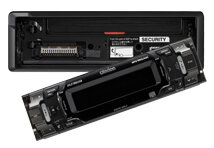
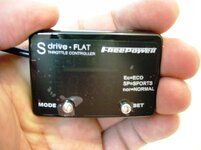
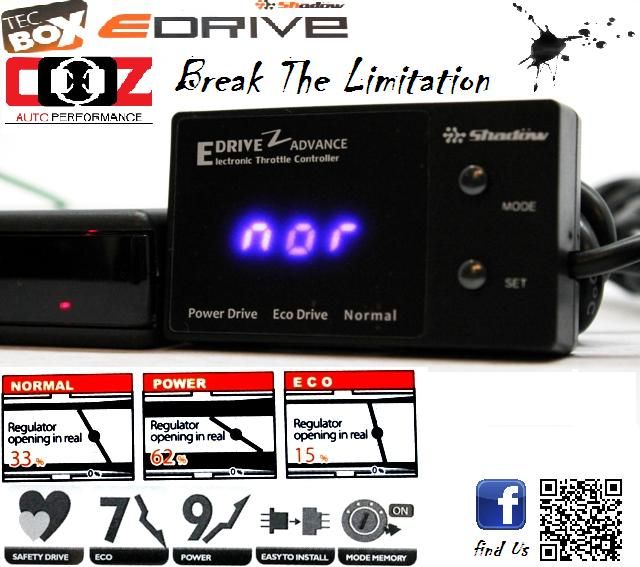
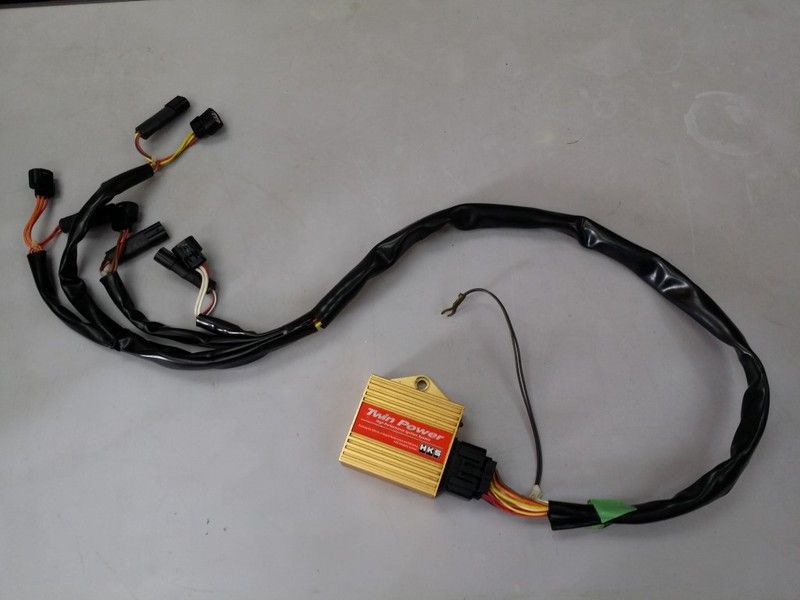
An Engine Control Unit (ECU) also known as an Engine Control Module (ECM) or Powertrain Control Unit/Module (PCU, PCM) if it controls both an engine and a transmission, is an electronic control unit which controls various aspects of an internal combustion engine's operation. The most simple ECUs simply control the quantity of fuel injected into each cylinder each engine cycle. More advanced ECUs found on most modern cars also control the ignition timing, Variable Cam Timing (VCT), the level of boost maintained by the turbocharger (in turbocharged cars), and control other peripherals.
ECUs determine the quantity of fuel, ignition timing and other parameters by monitoring the engine through sensors. These can include, MAP sensor, throttle position sensor, air temperature sensor, engine coolant temperature sensor and many others.
Before ECUs most engine parameters were fixed. The quantity of fuel per cylinder per engine cycle was determined by a Carburetor.
http://img441.imageshack.us/img441/9995/ecuus6.jpg
Operations
Control of Fuel Injection
For an engine with fuel injection, an ECU will determine the quantity of fuel to inject based on a number of parameters. If the throttle pedal is pressed further down, the ECU will inject more fuel. If the engine has not warmed up yet, more fuel will be injected (causing the engine to run slightly 'rich' until the engine warms up).
Control of Ignition Timing
A spark ignition engine requires a spark to initiate combustion in the combustion chamber. An ECU can adjust the exact timing of the spark (called ignition timing) to provide better power and economy. If the ECU detects knock, a condition which is potentially destructive to engines, it can delay (retard) the timing of the spark to prevent this.
Control of Variable Cam Timing
Some engines have Variable Cam Timing. In such an engine, the ECU controls the time in the engine cycle at which the valves open. The valves are usually opened later at higher speed than at lower speed. This can optimise the flow of air into the cylinder, increasing power and economy.
Programmable ECUs
A special category of ECUs are those which are programmable. These units do not have a fixed behavior, but can be reprogrammed by the user.
Programmable ECUs are required where significant aftermarket modifications have been made to a vehicles engine. Examples include, adding or changing of turbocharger, adding or changing of intercooler, changing of exhaust system, conversion to run on alternative fuel. As a consequence of these changes, the old ECU may not provide appropriate control for the new configuration.
In these situations, a programmable ECU can be wired in. These can be programmed/mapped while the engine is running by connecting a laptop to it using a serial or USB cable.
For example the programmable ECU may control the amount of fuel to be injected into each cylinder. This varies depending on the engine's RPM and the position of the gas pedal (or the manifold air pressure). The engine tuner can adjust this by bringing up a spreadsheet-like page on the laptop where each cell represents an intersection between a specific RPM value and a gas pedal position (or the throttle position, as it is called). In this cell a number corresponding to the amount of fuel to be injected is entered.
By modifying these values while monitoring the exhausts using a wide band lambda probe to see if the engine runs rich or lean, the tuner can find the optimal amount of fuel to inject to the engine at every different combination of RPM and throttle position. This process is often carried out at a dynamometer, giving the tuner a controlled environment to work in.
Other parameters that are often mappable are:
-Ignition : Defines when the spark plug should fire for a cylinder
-Rev limit : Defines the max RPM that the engine is allowed to rev to. After this fuel and/or ignition is cut.
-Water temperature correction : Allows for additional fuel to be added when the engine is cold (choke).
-Transient fueling : Tells the ECU to add a specific amount of fuel when throttle is applied.
-Low fuel pressure modifier : Tells the ECU to increase the injector fire time to compensate for a loss of fuel pressure.
-Closed loop lambda : Lets the ECU monitor a permanently installed lambda probe and modify the fueling to achieve stoichiometric (ideal) combustion.
Some of the more advanced race ECUs include functionality such as launch control, limiting the power of the engine in first gear to avoid burnouts. Other examples of advanced functions are:
-Waste gate control : Sets up the behavior of a turbo waste gate, controlling boost.
-Banked injection : Sets up the behavior of double injectors per cylinder, used to get a finer fuel injection control and atomization over a wide RPM range.
-Variable cam timing : Tells the CPU how to control variable intake and exhaust cams.
-Gear control : Tells the ECU to cut ignition during (sequential gearbox) upshifts or blip the throttle during downshifts.
http://img441.imageshack.us/img441/518/flashpe2.png
A race ECU is often equipped with a data logger recording all sensors for later analysis using special software in a PC. This can be useful to track down engine stalls, misfires or other undesired behaviors during a race by downloading the log data and looking for anomalies after the event. The data logger usually has a capacity between 0.5 and 16 Mbytes.
In order to communicate with the driver, a race ECU can often be connected to a "data stack", which is a simple dash board presenting the driver with the current RPM, speed and other basic engine data. These race stacks, which are almost always digital, talk to the ECU using one of several proprietary protocols running over RS232, CANbus or ethernet.
ECU 'flashing'
Many recent (around 1996 or newer) cars use OBD-II ECUs that are sometimes capable of having their programming changed through the OBD port. Automotive enthusiasts with modern cars take advantage of this technology when tuning their engines. Rather than use an entire new engine management system, one can use the appropriate software to adjust the factory equipped computer. By doing so, it is possible to retain all stock functions and wiring while using a custom tuned program. This should not be confused with "chip tuning", where the owner has ECU ROM physically replaced with a different one -- no hardware modification is (usually) involved with flashing ECUs, although special equipment is required.
Factory engine management systems often have similar controls as aftermarket units intended for racing, such as 3-dimensional timing and fuel control maps. They generally do not have the ability to control extra ancillary devices, such as variable valve timing if the factory vehicle was a fixed geometry camshaft or boost control if the factory car was not turbocharged.
Early ECUs
Early ECU designs were based more on analogue computer circuitry. It was not until around 1987 that digital electronics and embedded microprocessor systems became fast enough to process engine parameters in real time. The first such systems were introduced into racing engines such as those used for Formula One, but it was not long before these found their way into everyday cars.
Modern ECUs
Modern ECUs use a microprocessor which can process the inputs from the engine sensors in real time. An electronic control unit contains the hardware and software (firmware). The hardware consists of electronic components on a printed circuit board (PCB). The main component on this circuit board is a microcontroller chip (CPU). The software is stored in the microcontroller or other chips on the PCB, typically in EPROMs or flash memory so the CPU can be re-programmed by uploading updated code. This is also referred to as an (electronic) Engine Management System (EMS).