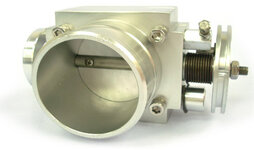
u mean the most is 64mm then any larger no more benefit? from 60mm to 64mm can give any gain?
It's not a matter of which is better, but what suits your engine.
Throttle bodies are tapered for a reason, it's to create the 'venturi' effect (google this term up for detailed explanation)
The venturi effect is to promote flow speed, in which case, it helps accelerate the air into the plenum of the intake, creating inertia for the air.
The TB plate size is for the amount of air you can flow at a certain speed, if you can flow more at a reasonable speed, then you will probably need something a lot bigger than 64mm.
higher revving engines can suck air a lot faster than standard ones, which is why honda B-series TB is a lot bigger than most other makes of similar capacity.
Some people eliminate the taper and go direct, but IMO, those are probably suited for turbos, which is why most NA TB's are always tapered.
TB sizing also differs from manufacturer to manufacturer, some spec butterfly plate size, some specify taper size, which makes things a little confusing.
If you can evaluate the flow of your engine, then you can estimate how big you need to go. The honda ECU works on the speed density principle, and it has the IAT and the MAP sensor, and this is a help in determining TB size.
for a B16, it's about 60mm, (through my experience of messing with my car) and going any bigger simply makes me hit zero vaccuum (100Kpa atmospheric) a lot earlier than 100% TPS. Of course, this is for B16's rev limited to 8-8.5K, you can probably run the R's 62mm at 9K, and it should offer some improvement.
In the end, you can simply go bigger and hence avoid buying too little a TB, but FC will suffer, and part throttle response too (though can be eliminated by tuning)
But too big will kill part throttle/low end power too, because the venturi effect no longer efficient. So you can buy a little bigger than stock, but not too much.
I wonder how many B18C's run 70mm TB's and realized this.