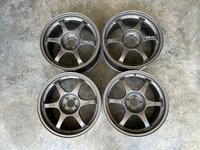
want to ask ar
since up to now, every rim (even new) require to stick some balancing stone. Does this happen to these 'top rim' as well?
actually the rim itself if u r talking about new from box,normally most rims is totally balanced mean they don't need any "balancing weight" aka so call stone to balance any uneven/balance point of the rims. When u install a new tyre to the rims, there will bound to be some imbalance point among the whole rims n tyre becos tyre is make from rubber and they are very elastic to cushion impact and weight of car body. Thats why u need to do balancing to counter any uneven point. From what i gather and experience,once in a while I will come accross those without need to do any balancing even if its a stock rims,basically becos the rims and the tyres is fitted evenly without any unbalanced out,hence we call it "perfect",no need balancing,it doesn't matter whether its stock or expensive rims.
here is something for u to read about tire balancing,source from wikipedia.org:
Tire Balance, also referred to as tire imbalance and tire unbalance, describes the unsymmetrical distribution of mass within a tire. When the tire rotates, such non-symmetries generate centrifugal forces that are transmitted into the vehicle. These forces give rise to ride disturbances, usually vertical and lateral vibrations. Since tire imbalance is a centrifugal force affect, it is speed dependent, to the ride disturbance increases with speed. Vehicle suspensions can be excited by tire imbalance forces when the tire rotating frequency equals the suspension’s resonant frequency. Tires are inspected in the tire manufacturing factories by two methods, static balancers and dynamic balancers. Tires with high imbalance forces are downgraded or rejected. When tires are fitted to wheels at the point of sale, they are measured again, and correction weights are applied to counteract the combined effect of the tire and wheel imbalance.
[edit]
Static Balance
Static Balance is measured by a machine where the tire is place on a vertical non-rotating spindle tool. The spot on the tire where the mass is greatest is acted on by gravity to deflect the tooling downward. The amount of deflection indicates the magnitude of the imbalance. The angle of the deflection indicates the angular location of the imbalance. In tire manufacturing factories static balancers operate by use of strain gauges mounted on the spindle assembly. In tire retail shops static balancers are most usually bubble balancers, where the magnitude and angle of the imbalance is observed by looking at the center bubble in an oil-filled glass sighting gauge.
[edit]
Dynamic Balance
Dynamic balance describes the forces generated by the non-symmetrical mass distribution when the tire is rotated, usually at a high speed. In the tire manufacturing factory the tire is mounted on a test wheel, the assembly is accelerated up to a speed of 300 RPM or higher, and strain gauges sense the oscillation in forces as the tire rotates. These forces are resolved into values (usually in units of ounce-inches) for the upper and lower plane of the wheel, and compared to the allowable manufacturing limits. Upper and lower plane values are combined to calculate the couple value (moment) due to the imbalance, which is also compared to allowable limits. In tire retail shops tire/wheel assemblies are checked on a spin-balancer, which determines the amount and angle of correction weights to be added to the outer flange and inner flange of the wheel, as needed to reduce the imbalance effect.