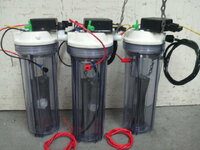
DIY Water powered car

imoloq said:
The flame front of the explosion travels 1000x faster than the flame front of a gasoline+oxygen explosion.
That's exactly the property that we want from burning hydrogen. No the energy level it possesses.
 
c-ground said:
it bubbles without any electrolyte at 12V? The water must be pretty dirty.. hehe!

BTW, what kind of electrode you tried on?

I tried it and posted it http://www.zerotohundred.com/newforums/showpost.php?p=1602585&postcount=38.

electrodei use is aluminium.. but afterwards it became oxidized a bit. the best is still stainless steel. the water used is tap water.. yes it prob dirty with clorine etc..
afterwards there are some salt type substance on water surface.

Sodium Hydroxide? wer u get it? that is like soap rite? tats not acidic.. its ermm..
i think a bit alkaline is it?? (sori my chem rusty). what they say is suposed to add acid.. air suling is better (pure water). then add a few drops of vinegar. havent try it since no stainless steel.
 
donCityZ said:
electrode i use is aluminium.. but afterwards it became oxidized a bit. the best is still stainless steel. the water used is tap water.. yes it prob dirty with clorine etc..
afterwards there are some salt type substance on water surface.

Sodium Hydroxide? wer u get it? that is like soap rite? tats not acidic.. its ermm..
i think a bit alkaline is it?? (sori my chem rusty). what they say is suposed to add acid.. air suling is better (pure water). then add a few drops of vinegar. havent try it since no stainless steel.

Don't use aluminum. It will be oxidized at the anode and eventually an aluminum oxide film on the anode if formed. This will stop the flow of electric current through the electrolyte.

I have a laboratory and there's where i got the alkali from.

BTW, either acid/alkali or salt, they serve as electrolyte. But if producing H2 and O2 is of the riority, make sure that there's no Cl-, NO3-, SO4-- in the electrolyte.
 
Last edited:
how about try using cheap container first
like plastic casing of carbonated drinks?
after ok, then u can buy water filter casing.
i will try using cheap stuffs first. difficult to find
tho.. all need to shop around h/ware shop..
here there..
 
how about using a stainless steel container?

The container can act as the cathode (-ve). Put an stainless steel anode in the middle. A stainless steel mug can be a good candidate.
 
cground..
good idea!.. eliminate the need for container in the first place!
the anode can we use the stainless steel wool used to
clean those pot butt? are those stainless steel? it should
be stainless steel right? coz it never rusted... right?
 
not sure but it really never rusted.. just make sure that the electrodes don't touch each other. You don't want to get a spark in the hydrogen-rich chamber.. haha!
 
c-ground said:
not sure but it really never rusted.. just make sure that the electrodes don't touch each other. You don't want to get a spark in the hydrogen-rich chamber.. haha!

To eliminate this danger, make sure the water level is always above the electrodes. The bonus is that the "effective" electrode plate area is also larger.
 
and im thinking about putting a small
gas reservoir/filter to avoid backfiring.
from big tank, gas flow to bottom of
small tank filled with water, then H+O
bubbles go out fr small tank to air intake.
 
donCityZ said:
and im thinking about putting a small
gas reservoir/filter to avoid backfiring.
from big tank, gas flow to bottom of
small tank filled with water, then H+O
bubbles go out fr small tank to air intake.

Yup, your device is called a bubbler. It prevents flashback from the engine and prevents your car from being a "Highway Hindenburg".
 
it can also sort of "filter out" the electrolyte carried in the hot vapour of steam + H2 + O2.... it gets pretty hot after a while.

Anyway, these are the photos i took when i tried it out last few nights.

http://drexchan.fotopic.net/c1067126.html

/drex
 
Wow! C-ground is in what field? how bout JSwong...so geng one their knowledge? really would like to know.

anyway, as i used to think, electrolysis of water is not so easy becoz it needs some acid to happen, even in small amount, just like in school lab. if acid was added, then the one of the electrodes will have anion build up on it and then become useless eventually.
one elctrode wil produce hydrogen, while another wil produce the anion from the acid and also the oxygen.
extracting both the gasses may be tricky, also storing it under pressure right after extracting.
after seeing C-grounds raw experiment, i figured the solution probly got hot becoz Hydrogen was reacting with Oxigen again to form water. OR the Natrium deposited on the aluminum reacted again with the water to produce NaOH again. When u thorw a piece of pure Natrium into water, u get a sizzling peice of Natrium speeding around while burning and then turning into NaOH. I guess inside the bottle it was happening as soon as it deposited on the aluminum electrodes so you don't see the fire.
Platinum would be an ideal electrode but its not cheap, get from jewelry shop lah haha, platinum is inert, but the only problem is being coated by elements from the solution and then its effectiveness is redueced.
in school experiments, each electrode were covered with a test tube, the solution could move but the gasses produced were isolated. one kind of gas for each electrode. then we removed the test tubes and quickly tested it with a "kayu uji berbara" LOL, POP for hydrogen and the oxygen lights up the other stick.
storing Hydrogen is a bit of a problem becoz somehow, hydrogen can leak out of its tank, corrode some metals n stuff, forgot where i read it. using carbon nanotubes is tricky, i'm not well versed in this at all. being porous and tube like, Hydrogen would just pass through.
water has natural buffer in the form of calcium carbonate and carbonic acid, it also has trace amounts of chlorine even if it is distilled.
 
Last edited:
one elctrode wil produce hydrogen, while another wil produce the anion from the acid and also the oxygen. extracting both the gasses may be tricky, also storing it under pressure right after extracting.

That's why I use NaOH, an alkali that produce only OH- anion.

after seeing C-grounds raw experiment, i figured the solution probly got hot becoz Hydrogen was reacting with Oxigen again to form water. OR the Natrium deposited on the aluminum reacted again with the water to produce NaOH again.

Wrong. I use stainless steel electrode. No reaction on it. Also, only H2 will be produced on the cathode. Na has nochange at all as it required higher energy to reduce Na+, than H+. The solution gets hot because of the current flowing through.. not because of any chemical reaction.

storing Hydrogen is a bit of a problem becoz somehow, hydrogen can leak out of its tank, corrode some metals n stuff, forgot where i read it. using carbon nanotubes is tricky, i'm not well versed in this at all. being porous and tube like, Hydrogen would just pass through.

No one wants to store the H2 gas. It's produce on-board, in-situ and on-demand.

Carbon nanotube.. well, you can't really see the tube.. it appears in small fine powder. The tube can only be seen under electron microscopes. It's not used to contain the gas, but to absorb the gas by physisorption on it's surface. Being nanoporous, the effective surface area is in the thoudsands meter square per gram.

water has natural buffer in the form of calcium carbonate and carbonic acid, it also has trace amounts of chlorine even if it is distilled.
trace amount of Cl2 is not a problem. Accessive Cl2 will produce HCl acid after the combustion.
 
Wah...i stand corrected kao kao
C-ground, what really is your education background? you are really interesting.
time for me to really study better lah...really lost in science.:mouth_closed:
 

Similar threads

Posts refresh every 5 minutes


Search

Online now

Enjoying Zerotohundred?

Log-in for an ad-less experience