Caya lah C-ground and Differ! The link is inaccessible, though.
Once upon a time, I regularly checked out sites like Keelynet and Stardrive to look for 'alternate' science involving 'magnetic motors' and homopolar generators.. you know, things that fall into the category of 'zeropoint energy' or 'free energy'.
But ever since getting more well-versed in physics and shit, I find that a lot of the stuff doesn't make sense.. There is still a possibility that those magnetic motors work, and there IS such a thing as zeropoint energy (think of it as the energy of the quantum vacumm), but it's just not so easy to acquire and exploit.
Permanent magnets are a potential source of 'free' energy obviously, because the minimum 'ground' energy of the electrons is determined by the quantum vacumm.. the energy level is quantized, so there's perpetually a minimum energy level that doesn't diminish, it's like a feedback loop - the electrons tap energy from the quantum vacumm to radiate virtual photons (magnetic force), and the magnetic field polarizes the surrounding quantum vacumm. That's a 'free' energy concept that's readily exploitable.
Hydrogen can't really be made to be inert, because its potential as an energy source depends on it being THAT reactive. If we make it inert, it's of as much use towards combustion as carbon dioxide or nitrogen is.
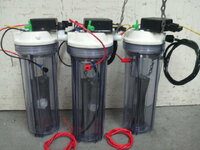
What we can do is to contain the hydrogen safely. In the case of that Hydroxene shit, they say that the hydrogen that is produced is kept inside a container no larger than a small paper cup, and it has no combustion risk. Even if it does catch fire, the explosion will be very small, they claim.
If we contain it within structures like carbon nanotube, it will involve entirely new nanotech methods to process. Probably it would involve vibrations or resonance of the nanotubes in a certain way to 'hold' and to 'release' the hydrogen atoms? For instance, generate a standing wave within the nanotube with respect to the hydrogen's natural oscillation frequency, so we keep them all stationary and in-line.. and then introduce a multiphase vibration to create a vibratory 'peristaltic' effect to 'push' them out when we want to release them. Maybe something like that could work, who knows, but it would be tedious and we're still a long way off from finding a workable method to do this.