The 2005 Top Gear Awards

zan said:
yeah, let me sample some bad mercs..

190E - small and cramped.
G class - the slowest jeep of all, doesnt deserve SUV badge.
M class - another bad attempt by merc
A class - looks can be deceiving, the A class failed the elk test during 1st media presentation and rolled over ashamingly.

Actually the 190-E was developed by Mercedes in the 80s to go into WRC (I'm not joking) they figured out something small in size, add superchargers with rear wheel drive (back in the 80s all Rally cars are using RWD) but then they were given a huge teutonic blow by Audi with their Audi Ur Quattro. (Which it swept all Rally and Grand Touring championships since it was launched) So Mercedes ended up mass producing it for public, then go into DTM race. Then there was a special 190 Cosworth edition to challenge M3 E30, but was overshadowed and hence forgotten.

G-Class is actually not an SUV, its a full blown capable off roader, not some Harrier/CRV like SUV. Hence the crude ride and understated performance.

M-Class is actually rather the trend setter of big, luxurious off roaders which spawned the Range Rover (Back then Range Rover wasnt considered a luxury vehicle, but since the M-Class, Range Rover was made luxurious) and those like Touareg, Cayenne and so on. Jurassic Park 1993 remember?

A-Class was just an Elk Test away from getting the European COTY awards when its launched. Its just a minor fault that led to the overturned one tested by that stupid journalists who thought he's testing a Ferrari. In everything else, the A-Class is another revolution, the sandwhich platform with a tilted engine on rails allows the engine to slide downwards under the passengers during a frontal collision (this is the most life threatening kinda accident where in normal cars, engines were compressed into the body shell, then dashboards and scraps of metal pushed inwards and kill front passengers. A-Class actually deserves itself a COTY award and probably a Noble Prize.

The real problem with current Mercedes is actually, no problem at all. Its that for the past 5-6 years, Mercedes had given a very bad reputation to consumers. This is because around the turn of the century, Daimler Chrysler felt the pressure from the onslaught of competitions from large conglomerates, Japanese vehicles moving upmarkets, eating up their market share, hence they decided to increase profit margins for their vehicles, this is due that their engineers found that their vehicles (since long) was deemed over-engineered, using parts that are considered too good that it threatened their own new products, hence they decided to source for more "appropriate" materials that are better in terms of cost efficiency. They cut back their "Customer is beyond King" kinda service and aftersales support. This eventually, became a major backlash, hence nowadays consumers were terrified (at least in Europe and US) of Mercedes' quality. For example the current on-going E-Class, the first two batches were known to have prone failures on their gearboxes, transmissions. But Mercedes actually reiterated all these problems recently and i believe, they are better now. (See? all these problems weren't seen by Malaysia's brand conscious consumers)
 
The usual people who buy Mercs in Malaysia haven't a clue about cars. All they know is Mercedes = Expensive = Good.
 
M-Class is actually rather the trend setter of big, luxurious off roaders which spawned the Range Rover (Back then Range Rover wasnt considered a luxury vehicle, but since the M-Class, Range Rover was made luxurious) and those like Touareg, Cayenne and so on. Jurassic Park 1993 remember?

...the Clarkson article on M-Class which appeared yesterday in NST's CBT is worthy to be read first.

And it's The Lost World.
 
dont get me wrong...he he i was in love with Merc 500SEC W126 in AMG spec back in 1986. it was only a Matchbox product of coz, but astonishing nevertheless.

190E was built as the big boys at merc as of that time were thinking making a baby Merc to counter the 3 series from BMW in the all important junior exec segment. tell me my friend when u r making cars which is more important? to sell or to win races?

its the selling laa of coz. profit making maa...and by doing race promo (or rally in this case) it will directly generate more sales. but the main intention remains same - to compete with BMW who is enjoying huge sales from 3 series.

have you heard that there is a 190 model with 1.8 carb engine? it wud be nice if we can have it back in the 80s. 190E 2.3-16 Cosworth is a good car though, as the 190E 2.6

there is no SUV in 1980s when G class was launched. the term SUV only heard recently but now it was meant for all jeeps with all wheel drives capability bar the pick-ups. maybe 'jeep' is not appropriate to use as it is actually a brand. remember Jeep Cherokee?

the turbodiesel model was the slowest amongst all...i have to search my archvies first to find proofs. may take some time...

W124 is an all time love affair, as well as W210, W211, W202 and W203.
 
Last edited:
Once in a while, a car manufacturer will build a car to race first, to make money second.

And thus we all become familiar to the term homologation.
 
SubVerSiv said:
Once in a while, a car manufacturer will build a car to race first, to make money second.

And thus we all become familiar to the term homologation.

tell me what car in the world was created for race first before production.

he he really like to know. cheers.
 
The Lancia Stratos HF (homologated in FIA Group4, the GroupB predecessor)
The Ford Escort RS1600/RS1800 (homologated in FIA Group4)
The Fiat 131 Abarth (homologated in FIA Group4)
The Audi Sport Quattro (homologated in GroupB)
The Lancia 037 a.k.a. rally (homologated in GroupB)
The Lancia Delta S4 (homologated in GroupB)
The Lancia Delta Integrale (all versions including the Delta 4WD with the exception of the Evoluzione II)
The Subaru Impreza Turbo (pre-1997 models)
The Toyota Celica GT4 (all versions)
The Ford Sierra RS500
The Ford RS200 (homologated in GroupB)
The Ford Sierra RS Cosworth
The Ford Sierra RS Cosworth 4x4
The Ford Escort RS Cosworth (the pre-1995 Garrett T03/04B turbo equipped cars)
The MG Metro 6R4 (homologated in GroupB)
The Nissan Sunny (Pulsar) GTiR
The Peugeot 205 Turbo 16 (homologated in GroupB)
The Porsche 959 (homologated in GroupB)
The Mazda 323 turbo 4x4 (all versions)
The Mitsubishi Lancer Evolution (all pre-Evolution VII versions)
The Renault 5 Turbo (homologated in GroupB)
The Volkswagen Golf G60 Rally

In order for a vehicle to be able to take part in FIA approved races it has to be produced to a minimum number of units by its manufacturer, 5000 for the GroupN class, 2500 for the GroupA class and 200 for the now extinct GroupB. These units have to be similar, in aspect and mechanically, to the ones that will effectively take part in racing i.e. if the racing vehicle has a 4 wheel drive transmission so must also have the homologation base vehicle. Certain mechanical and electronic parts that are present in the racing vehicle must also be present in the homologation base unit. If modifications are required to the competition version then a new series of street going vehicles that include them will have to be produced. These cars were bred by racing for racing.

Q: Can a company really make profit by selling 200, 2500 or 5000 cars?
 
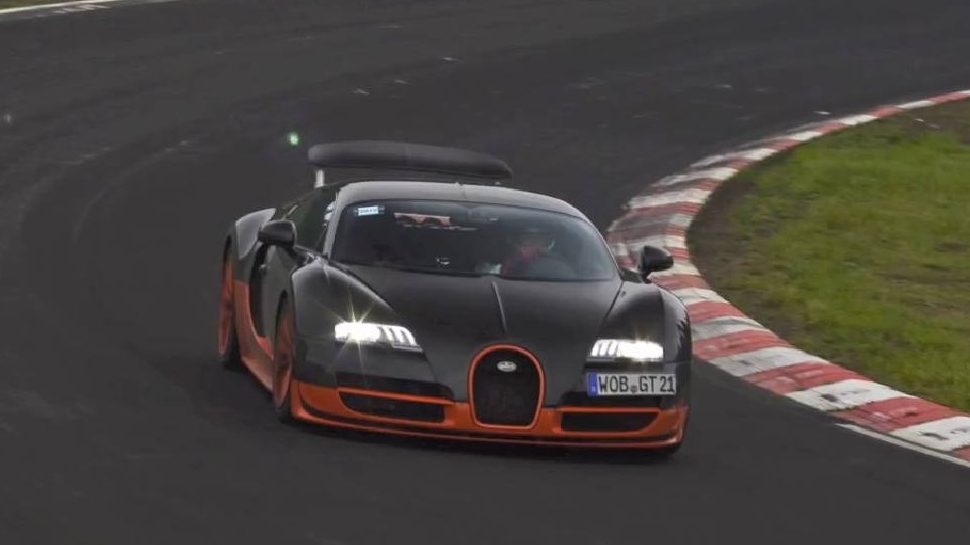
Q: Can Bugatti make money by selling the Veyron?

But of course, Veyron is not a case of homologation.
 
Q: If there are no FIA approved races, can these cars see the light of production?
 
group B racing cars are all based on production siblings.

aside from Lancia Stratos and Lancia 037 (which i am not familiar with - probabl older than me) i can say only Ford RS200 is unique by being a truly Group B car.

homologation is one thing, but there will never be a manufacturer who manufacture cars for racing purpose before thinking of puting into production.

the R&D alone is painstaking and cost a bomb.

The Ford Escort RS1600/RS1800 - there were always Escort in production before Focus started sales.
The Fiat 131 Abarth
The Audi Sport Quattro started life in 1985
The Lancia Delta S4 (based on Lancia Delta)
The Lancia Delta Integrale (based on Lancia Delta)
The Subaru Impreza Turbo (1st Impreza Turbo 4WD began sales in 1994)
The Toyota Celica GT4 (GT4 was the 4th Celica model since its 1st intro)
The Ford Sierra RS500 (based on Sierra)
The Ford RS200 (the only car built for racing purpose, limited)
The Ford Sierra RS Cosworth (Sierra and Sierra Sapphire Cosworth are actually road cars tuned by Cosworth for mass sales)
The Ford Sierra RS Cosworth 4x4 (refer above - only with 4WD)
The Ford Escort RS Cosworth (similar case to Sierra, Ford found the Sierra was a litlle too big a size for rallying hence the change to Escort)
The MG Metro 6R4 (MG Metro is based on Austin Metro of mid 80s)
The Nissan Sunny (Pulsar) GTiR (based on Sunny)
The Peugeot 205 Turbo 16 (based on 205 of 1984)
The Porsche 959 (959 is actually a 911 with 4WD and world's 1st 6 speed gearbox. All new body)
The Mazda 323 turbo 4x4 (all versions)
The Mitsubishi Lancer Evolution (based on Lancer)
The Renault 5 Turbo (based on Renault 5 GT Turbo of 1986)
The Volkswagen Golf G60 Rally (based on Mk111 Golf)

my reference is Performance Car mag 1987 edition where they conducted group tests of all Group B racing cars including Citroen BX 4x4
 
subversif, no offence to you but if you were asked to lead a car manufacturer (not necessarily proton),

would you think of doing so - spending RMbillions to make a race car then only decide to produce them for recovery.

i wouldn't think of doing so, the risk is just too high. othewise, proton should have done that and make millions.
 
Your perception and his, is slightly different. You perceived what he said as : "To produce solely for racing purposes, and not money making purposes."

What he meant, is that certain products are not made in money making objective, but rather racing purposes, and then to produce them to sell as well, to make up for the reputation, marketing purposes, brand strengthening. Alot of cars weren't made to generate profit, its there for other purposes, which helps other models sell.

Take Mitsubishi Evolutions for example, their main purposes were to compete in Rally, hence the development for it, it doesn't mean that Mitsubishi had WRC in mind, then only they sell Lancer. Wrong, but it meant Mitsubishi had Lancer in mind (to generate sales), hence WRC for Evo (to strengthened Lancer's racing, handling heritage), then only sells Evolution to the masses (to strengthened the brand image to masses as Evo's are moving advertising billboards for Evo).

NSX as well, it wasn't really created to race in either JGTC or DTM or whatever, it's created in the early 90's where its the romantic period where all Japanese manufacturers are trying to get a hold of the European/ American car markets. They produced their own intepretation and versions of supercars, all had their own special characteristics and are highly engineered. Honda made minor losses with each NSX sold because of the costly aluminium construction.

Selling cars make money, yes undoubtly. But strenghthening the brand, advertising could help make more money. Why people perceived BMWs as the Ultimate Driving Machine? Why people perceive Toyota's as reliable? It's almost 30% true, and 70% marketing to strengthened the way people think about their vehicles.

Well, all in all, its just a summary of my understanding and the facts i know. One can have many thoughts and opinion. :)
 
zan, 'based on' means that it's not the same car. Model names and versions are given for a reason.

Money is king, but most of the car companies in Europe were established by passionate enthusiasts (like us?). Lotus, Noble, TVR, Ascari, Pagani, KoenigSegg, Ariel don't make much profit (or didn't made any at all), but look at their cars. Look at Lotus: unbelievably flawless products, regarded as the best-handling cars by enthusiasts all over the world (US included), yet the company was bought by Proton.

You can see the same enthusiasm among the participants of our annual Merdeka race: workshop owners, etc.

You can read about the same passion among the Bugatti Veyron engineers.

Once in a while, it's not about money. Once in a while.
 
A case of mad enthusiasm and building a pride

253 MPH and Still a Little Late

By Dan Neil, Times Staff Writer

PALERMO, Sicily — At 200 mph, the Bugatti Veyron pounds a beautiful, howling hole in the sweltering haze hanging over the motorway.
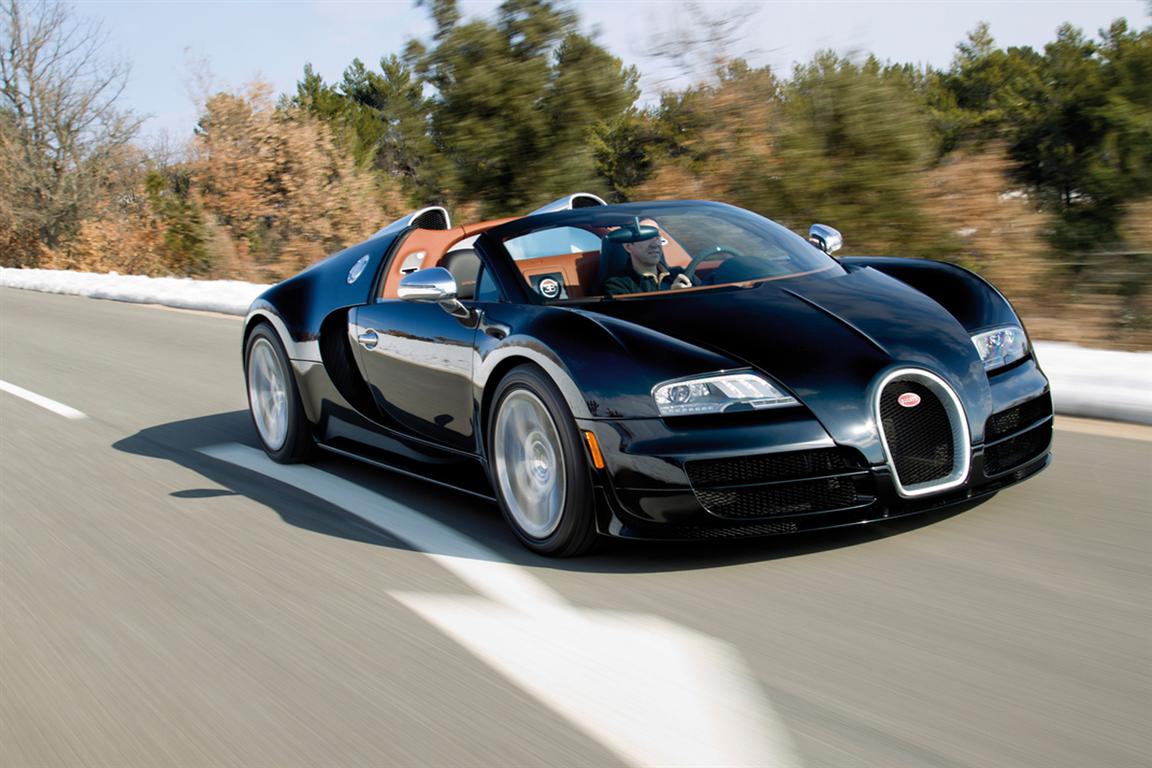
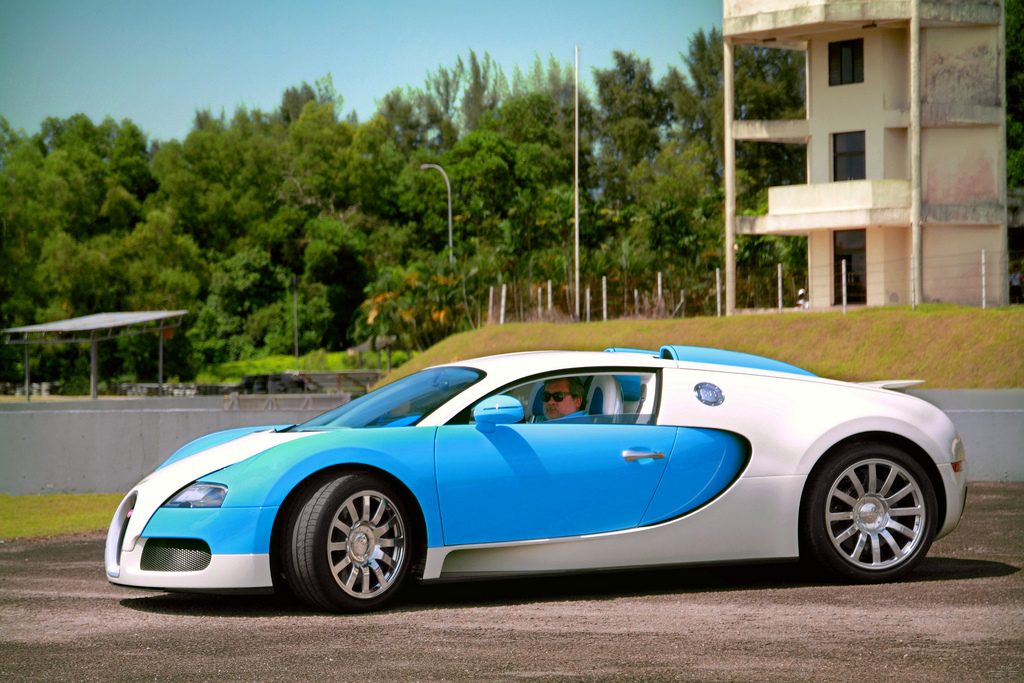
This, the fastest production car in the world, is broad and low, an enameled ellipse in a spiffy two-tone paint scheme. By comparison, its now-vanquished supercar rivals, such as the Ferrari Enzo and McLaren F1, are all edges and blades and angles, like F-16 fighter planes or Japanese stunt kites.

The Veyron is not, strictly speaking, the fastest car I've ever driven, but the one that's faster had a jet engine and a parachute. The guardrail to my right is blurred into a dirty stream of quicksilver. Houses fly by before my brain has time to register the word "house." (The car weighed four times more than the Dodge Viper. The Veyron weighs 4,300 pounds, approximately 1,000 pounds more than the Viper.)

About nine seconds ago, I was dawdling at 100 mph. Then I squeezed the throttle. The seven-speed dual-clutch gearbox clicked twice, the engine took a huge lung-busting toke of atmosphere through its twin roof snorkels — and then things got interesting. Something slammed me from behind and I realize it was the seat. Captain, it appears we have fallen nose-first into a wormhole.

Two-hundred mph. And I'm not even in top gear.

house….

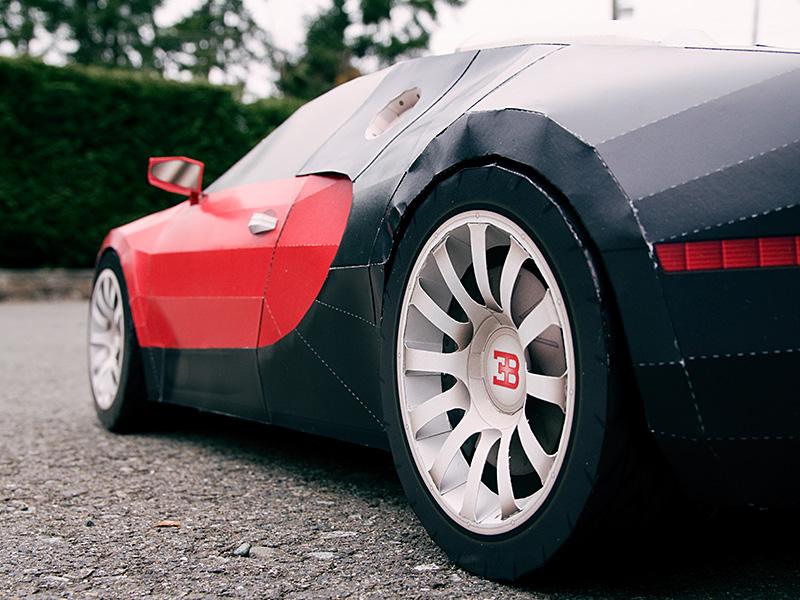
A superlative on four wheels, the Bugatti Veyron 16.4 is not only the world's fastest production car but also the most expensive: $1.25 million before taxes and richly deserved gas-guzzler penalties. Also, the most powerful: Its 8.0-liter 16-cylinder quad-turbo engine produces about 1,000 horsepower and churns it through a high-tech all-wheel-drive system and gob-smacking foot-wide tires. Also, the quickest: The Veyron accelerates to 60 mph in 2.1 seconds, faster than a Formula 1 car, but then it's just getting started. In 20 seconds — about the time it takes a fast reader to get through this paragraph — it reaches 200 mph. In 53 mind-blowing seconds, the Veyron reaches its marquee speed: 253 mph.

At that speed, the tires would begin to soften in about half an hour. Fortunately, at top speed, it runs out of gas in 12 minutes. "It's a safety feature," Wolfgang Schreiber, the Veyron's chief engineer, says with a smile.

The Veyron, which is making its way to the first customers this month, is many things: It's a mirror held to the automobile industry's near past of irrational exuberance. It's a monument to the ego of Ferdinand Piech, former chairman of Volkswagen AG, which purchased the Bugatti name in 1998. And it represents a defining moment in the history of the automobile, the likely pinnacle of production-car cost and performance. Six years and an estimated half a billion dollars in the making, the car trades on one of the most famous names in motoring. Revered among aficionados, Bugatti dominated Grand Prix racing for a time between the world wars and built sinfully beautiful works of transportation art, including the Type 57SC Atlantic and Bugatti Royale, which holds the Guinness record for the highest price paid for a car — $15 million.

Volkswagen was in tall cotton in 1998. Led by Piech, a prodigious engineer-designer and grandson of Porsche founder Ferdinand Porsche, the company went on a buying spree, acquiring the Italian carmaker Lamborghini, the British luxury marque Bentley and Bugatti.

This in itself wasn't unusual. The decade saw many storied firms absorbed by larger car companies: Ford, for instance, purchased Aston Martin and Land Rover, and BMW acquired Rolls-Royce. Volkswagen, riding a crest of record sales, had the money; its after-tax profit in 1998 was $1.2 billion.
Bugatti, however, seemed peculiarly cursed. It's doubtful that even Ettore Bugatti, the artist-engineer who founded the company in 1908, made money on the venture. In 1988, an Italian entrepreneur, Romano Artioli, purchased the rights to the name and built a state-of-the-art factory in Campogalliano, Italy, to produce a supercar called the EB110. Less than a decade later, in 1996, Bugatti was again bankrupt. What VW purchased amounted to no more than a glorious scrapbook.

Piech — unyielding and autocratic but possessed with a vision as pure, in its way, as that of Ettore Bugatti — promised that the new Bugatti would be VW's crown jewel, the ultimate in automotive technology. It was he who set the well-rounded parameters for the Veyron: 1,000 hp and faster than 400 kilometers per hour (248 mph). Such a car would eclipse the McLaren F1's seemingly unassailable record of 240.1 mph.

"Piech was maniacal," says Peter DeLorenzo, an industry analyst and founder of Autoextremist.com. "He was one of the great engineering geniuses of the late 20th century, but he proved that brilliance on the engineering side doesn't necessarily transfer to managerial vision."
Indeed, Volkswagen AG is a company in crisis, beset by plummeting market share around the world, high labor costs and — particularly in the crucial United States market — a dearth of new products in its bedrock brands such as VW. In addition to other problems, the company is embroiled in a sex scandal involving allegations the company paid for "sex junkets" for its labor representatives. Last week on the Frankfurt stock exchange, a VW share hovered around the 45 Euro mark, less than half its peak value in 1998. Piech was replaced as chairman in 2002 by Bernd Pischetsrieder, former chief executive of BMW.

By most accounts, Piech's failing was of the classical Greek hubris variety. "He was obsessed with putting VW onto a par with Ferrari," says DeLorenzo.

Piech's effort to drive the VW brand upscale produced the VW Phaeton, an eight- or 12-cylinder luxury sedan that costs as much as six figures in the United States (the company announced last month the Phaeton model was being discontinued). The Phaeton directly competes with another of VW Group's offerings, the Audi A8 sedan.

"I think [Piech's] crazy," says Mike Kamins, a professor at USC's Marshall School of Business. "The Phaeton just didn't make any sense. VW doesn't have that image and you can't change an image that fast. People ask what you paid for your car and you say, '$100,000,' and they say, 'Well, what kind of Porsche is it?' You say, 'No, it's a VW.' They say, 'What, are you stupid?' "

VW's bigger problem, analysts say, is that during Piech's reign it took its eye off developing its core product — cars like Golf, Jetta and Passat — while diverting engineering resources to exotica like the Phaeton, the new Bentleys, Lamborghinis and, of course, the Veyron.

"I think the Bugatti venture gets lost in the rounding error for the overall VW Group," says Jay N. Woodworth of Woodworth Holdings Ltd. "What really matters is that the successor to the main VW car lines has been delayed."

The result is that the Veyron — named after one of Bugatti's most successful race drivers, Pierre Veyron — has been born into a world very different from the one in which it was conceived. Other super-exotics, including Mercedes-Benz Maybach limousines, the SLR McLaren and Porsche's Carrera GT, haven't sold as briskly as was hoped when they were drawn up in the bubbly days of the late 1990s.

And, it should be noted, the executives who lead German car companies — people like Piech and Pischetsrieder, former DaimlerChrysler chief Jurgen Schremp and others — are intensely competitive, and the Veyron project had an almost irresistible logic for Europe's biggest automaker.

"I don't think it's dramatically different than the relationship among auto executives at country clubs at Detroit," Woodworth says.

Whatever the cause, the result is this artifact called the Veyron, a heroic and historic automobile.

Meanwhile, back at 200 mph, technical director Schrieber is urging me on. "This makes fun, doesn't it?" he asks.

The main autostrada of Sicily is not exactly glass-smooth, nor particularly straight, and as I bend the car into a sweeping right-hander at about 205 mph, a flock of butterflies the size of vampire bats alights in my solar plexus. The suspension is working hard and I can feel the static of the tires coming through the stitched-leather steering wheel. I am very curious to see if the car will hold the line in the corner or slide off into the heavenly yonder.

As fast as it is, the Veyron is actually late for its own party. The first Veyron 16.4 concept car appeared at the Tokyo Auto Show in fall 1999, and the final draft, so to speak, appeared in September 2001 at the Frankfurt auto show. The plan was to have cars to customers by the end of 2003, but the Veyron posed an unprecedented engineering challenge: a car capable of 250 mph that is civilized, safe and reliable — passing all the durability and crash-test standards that a VW Golf has to pass.

"Its performance was achieved through state-of-the-art engineering rather than simply shoehorning a giant engine into thinly disguised race car," says Csaba Csere, editor of Car and Driver magazine, who performed a max-speed test on the car this fall. "The Veyron is completely usable on the road and can be piloted by anyone with a regular driver's license."

When Schreiber took over the project in spring 2003, he says, there were about 500 technical issues with the car. It was too heavy. The dual-clutch gearbox was too noisy. The fuel pumps weren't sufficient to supply the gallons per minute the engine requires at full honk. And everything was too hot. The car now has 10 radiators, cooling components such as the hydraulics system and the gear-box oil.

But the biggest problem was air. At 200-plus mph, air is not the insubstantial nothingness of everyday experience but a thick, turbulent fluid that wants to pull the car off its wheels. To thwart what is known as aerodynamic lift, the Bugatti — like most race cars — has a wing, as well as a smaller spoiler, deployed on aircraft-grade hydraulics on the back. These keep the car from fluttering off the road like a thrown playing card. However, the same wing that provides down force also creates drag. As recently as March, the car was falling well short of the target speed of 248 mph.

Only when Schreiber and his engineers created what is now called the "top speed" configuration was the car able to achieve its maximum speed. It works like this: When the car reaches 137 mph, hydraulics lower the car until it has a ground clearance of about 3 1/2 inches. At the same time, the wing and spoiler deploy. This is the "handling" mode, in which the wing helps provide 770 pounds of down force, holding the car to the road. This drag-limits the car to about 230 mph.

To go faster, drivers have to stop the car and activate the top speed mode with a special key in a lock to the left of the driver's seat. This lowers the car to a ground-skimming clearance of about 2 1/2 -inches and retracts the rear wing so that it just peeks out over the bodywork. At 250 mph, a little wing angle is all you need. At the same time, openings for aerodynamic tunnels built into the car close, creating a fully flat-bottom car.

In April, Schreiber and his team had hit upon the ideal setup for the car and were putting down consistent 250 mph runs.

The Veyron has a lot of other tricks up its carbon-fiber sleeve. When the brakes are activated at high speed, the rear wing tilts to 70 degrees, creating what is effectively an air brake — should the 15-inch carbon-ceramic disc brakes not prove to be enough. Here is a fun fact: In a panic stop from 253 mph, the Veyron comes to a halt in less than 10 seconds — hard enough to pull the sunglasses off your face.

"My philosophy is that you should be able to brake better than you can accelerate," Schreiber says.

So it can go like the hammers of hell and stop on a pfennig. But will it sell? That is the $1.25-million question.

"It remains to be seen," says Peter Mullin, a Los Angeles car collector who owns several vintage Bugattis. "They certainly have put the resources into it. I just wonder what is the appetite for a car that can go 250 mph on the street? It's kind of a limited market."

And yet the "fastest car" superlative is indispensable to the car's mystique. The Veyron is the latest in a long list of what you might call dorm-room poster cars — cars with names like Lamborghini, Ferrari, Koenigsegg and Saleen.

"Once this car comes out, it will be the car that people think of when they think ultimate sports car," says Leslie Kendall, curator of the Petersen Automotive Museum. "It will be the new standard."

Bugatti has said it will build no more than 300 of the cars, optimally 50 to 80 per year. There will be 20 dealerships worldwide, including O'Gara Coach Company in Beverly Hills. Ehren Bragg, president of O'Gara, says the dealership has four orders in hand. The down payment is $413,000, enough to buy six Chevrolet Corvette Z06s.

O'Gara is expecting to make its first deliveries in August or September 2006, but it will have a demonstrator model. Bragg wouldn't be surprised if that car is bought off the showroom floor. "Here in Beverly Hills," he says, "when people can't have something, they want it more than they thought they did."

Even if Bugatti sells every car, it won't make a dime. "Volkswagen will only net about $350 million from the Veyron," says Car and Driver's Csere. "That's hardly enough to pay for the engineering, development and manufacturing costs of this car. But making a profit was never the point. The goal was to relaunch the Bugatti brand as a builder of noteworthy cars. That the Veyron has done."

Bugatti's president, Thomas Bscher, has said as much in the media. The idea is that the glow of the Veyron's halo will light up other products to come, possibly a four-seat coupe. But under VW Group's current financial constraints — and the fact that the gas-hungry world has shifted under the company's feet — it's possible the Veyron will turn out to be a magnificent anomaly.

"I would have some healthy skepticism of the survivability of these proposed products," Woodworth says. "They may never get off the launch pad."

When asked what he thinks of the Veyron's legacy, automotive marketing analyst Daniel Gorrell, in a literary turn, recalls some lines from Percy Bysshe Shelley:

"My name is Ozymandias, King of Kings:
Look on my works, ye Mighty, and despair!"

A story that'll make the so-called car enthusiasts in this country weep. Now, we will realize that we are only buyers, customers, users and maybe at most: tinkerers.

They're the builders and the engineers.
 
its getting warmer in here aint it? he he..

thanx for explaining things i had already knew. but i can say my question was hardly answered (or understood maybe?)

talk is cheap by the way... no offence; again.
 
subversif, no offence to you but if you were asked to lead a car manufacturer (not necessarily proton),

would you think of doing so - spending RMbillions to make a race car then only decide to produce them for recovery.

Hmmm... now what would a REAL leader of a car manufacturer like Dr. Ferdinand Piech do...

... or rather, did...

It's not getting warmer in here. It's getting dull.

Pardon my waywardness, but shall we return to the topic, gentlemen? The 2005 Top Gear Awards?
 
SubVerSiv said:
Hmmm... now what would a REAL leader of a car manufacturer like Dr. Ferdinand Piech do...

... or rather, did...

It's not getting warmer in here. It's getting dull.

Pardon my waywardness, but shall we return to the topic, gentlemen? The 2005 Top Gear Awards?

truly agree with you, lets get back to the original topic. have a nice day!
 
If i were asked to lead a car manufacturer like Proton, i'd threw out Malaysian governments share, sell myself to Volkswagen, get a German CEO, than bring the Bugatti Veyron and put it as the Ultimate Proton Bagus&Cepat. This Proton Bagus&Cepat will have a Twin Campro, meaning it would have a staggering 3.2 Liter 8 pot engine with 32 valves. churning out 280hp through its front wheel drivetrain, with a 5-speed otomatik tetapi manual gearbox (OTM - English AMT) then sell it at a price of RM99,999 with 10 years free maintenance (20 years power window warranty) :D
 

Similar threads

Posts refresh every 5 minutes


Search

Online now

Enjoying Zerotohundred?

Log-in for an ad-less experience