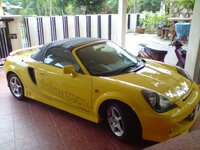
The first thing you will notice about the MR-Spyder is the power-to-weight ratio. At just 2200 pounds, it's one of the lightest sports cars made. That alone promises all kinds of tossability when we have a real drive in it, with responsiveness and steering feel, not to mention less passionate stuff like good gas mileage.
The power for this sports car comes from the same 1.8-liter twin-cam four-cylinder that sits in the new Celica. The difference is that the Celica application has the engine sitting transversely in front, while in Mr. Spyder it sits transversely behind the two seats and forward of the rear axle. That means excellent balance.
The VVT-i variable valve timing, which adjusts the timing, lift and duration of the intake and exhaust cams to provide maximum power for low, medium and high engine speeds, spreads the engine's power and torque across much wider bands than they would be with fixed cam timing.
So when you stand on the gas and go, the MR-Spyder will respond quickly, before anyone can say, ``Hey, where the @#*? do you think you're going?'' Peak horsepower is 140 and peak torque is 127 lb-ft.
The transmission in the car is easy and smooth to operate and engaged about as simply as the best shifters on the market. Matching revs and changing gears smoothly was about as easy to do on this car as on anything you will ever drive.
The unibody felt tight, there was no shifting of secondary chassis loads around corners or over bumps. Crawl underneath and poke around, you will find some interesting stiffening methods used on the Spyder body. Tubular steel stiffeners ran crisscross all over the car: from the suspension mounts to the body; from forward of the semi-trailing arms up to the midsection of a crossmember; from the front crossmember to the main body (four of them); diagonally across the engine bay (two welded together where they intersected). It was a unique solution to body rigidity. It almost looked like they were all added after the main design to increase the torsional rigidity and bending resistance, maybe because someone decided this had to be a convertible, but that would be a question we'd have to ask of the chief engineer.
And the car is fun to drive, reminiscent of the original MR-2. Had you been given an open track instead of a short stretch of semi-winding road along the beach, it felt as if the car could be throttle-steered, adjusting understeer or oversteer through a corner with appropriately timed use of the gas pedal. More spirited driving will tell for sure.
The suspension consisted of struts at all four wheels, the fronts controlled by lower stamped steel A-arms and the rears by lower parallel arms with semi-trailing arms. Brakes were four-wheel vented discs with two-piston calipers.
The body, well... For all the svelte shapes that could make up a two-seat roadster, all the shapes that designers probably had on their sketchpads, Toyota chose one from its Tokyo design lab that is more boxy than smooth. Proportionally the Spyder looks like the Porsche Boxster, which is good. It has the same short rear overhang, stubby corners and squat, ready-to-leap looks that a roadster should have. But the MR-Spyder's lines suggest more a mix of roundedness and New Edge that doesn't meld together as effortlessly as it could. The Boxster, for instance, is all smooth undulation, with no edginess to it, and hearkens back to the 550 Spyder of the 1950s.