correct real racer will buy inspira 1.8 manual...same bore, just find 2.0 stroker kit from proton...n itz car price cheaper too than 2.0 got no problem in gbox like cvt version.....kekekee then put racing clutch with short shifter...:) i like....
---------- Post added at 06:41 PM ---------- 6 hour anti-bump limit - Previous post was at 06:32 PM ----------
that mivec got variable lift n timing or timing only? both intake & exhaust or intake only?
if i not mistaken Mivec and Vtec they used same system (so power very near) not like those follower from T, H and N- VVT la, VVTI and so on....but no power or not enough power hahaha
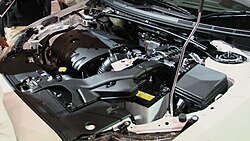
MIVEC (Mitsubishi Innovative Valve timing Electronic Control system)
MIVEC, as with other similar systems, varies the timing of the intake and exhaust camshafts which increases the power and torque output over a broad engine speed range while also being able to help spool a turbocharger more quickly.
Operation
Some types of variable valve control systems optimize power and torque by varying valve opening times and/or duration. Some of these valve control systems optimize performance at low and mid-range engine speeds. Others focus on enhancing only high-rpm power. MIVEC system provides both of these benefits by controlling valve timing and lift. The basic operation of the MIVEC system is altering the cam profiles and thus tailoring engine performance in response to driver input.
[8]
In essence, MIVEC serves the same function as "swapping cams", something that car racers might do when modifying older-design engines to produce more power. However, such swaps come with a compromise - generally yielding either greater low-end torque or more high-end horsepower, but not both. MIVEC achieves both goals. With MIVEC, the "cam swap" occurs automatically at a fixed
Revolutions per minute - Wikipedia, the free encyclopedia. The cam switch operation is transparent to the driver, who is simply rewarded with a smooth flow of power.
[8]
Two distinct cam profiles are used to provide two engine modes: a low-speed mode, consisting of low-lift cam profiles; and a high-speed mode. The low-lift cams and rocker arms - which drive separate intake valves - are positioned on either side of a centrally located high-lift cam. Each of the intake valves is operated by a low-lift cam and rocker arm, while placing a T-lever between them allows the valves to follow the action of the high-lift cam.
[8]
At low speeds, The T-lever's wing section floats freely, enabling the low-lift cams to operate the valves. The intake rocker arms contain internal pistons, which are retained by springs in a lowered position while the engine speed is below the MIVEC switchover point, to avoid contacting the high-lift T-shaped levers. At high speeds, hydraulic pressure elevates the hydraulic pistons, causing the T-lever to push against the rocker arm, which in turn makes the high-lift cam operate the valves.
[8]
In summary, MIVEC switches to the higher cam profile as engine speed increases, and drops back to the lower cam profile as engine speed decreases. The reduced valve overlap in low-speed mode provides stable idling, while accelerated timing of the intake valve's closing reduces backflow to improve volumetric efficiency, which helps increase engine output as well as reduce lift friction. High-speed mode takes advantage of the pulsating intake effect created by the mode's high lift and retarded timing of intake valve closure. The resulting reduced pumping loss of the larger valve overlap yields higher power output and a reduction in friction. The low- and high-speed modes overlap for a brief period, boosting torque.
[8]
From the
Mitsubishi 4B1 engine - Wikipedia, the free [email]encyclopedia@@AMEPARAM@@/wiki/File:Mitsubishi_4B11_engine.jpg[/email]" class="image" title="4B11 in a Mitsubishi Galant Fortis (8th generation Mitsubishi Lancer)"> thumb/6/6b/Mitsubishi_4B11_engine.jpg/250px-Mitsubishi_4B11_engine.jpg
 engine family onward, MIVEC has evolved into a
Continuous variable valve timing - Wikipedia, the free [email]encyclopedia@@AMEPARAM@@/wiki/File:Merge-arrow.svg[/email]" class="image"> thumb/a/aa/Merge-arrow.svg/50px-Merge-arrow.svg.png
 (CVVT) system (dual VVT on intake and exhaust valves).
[9] Many older implementations only vary the valve timing (the amount of time per engine revolution that the intake port is open) and not the lift. Timing is continuously independently controlled to provide four optimized engine-operating modes:
[9]
- Under most conditions, to ensure highest fuel efficiency, valve overlap is increased to reduce pumping losses. The exhaust valve opening timing is retarded for higher expansion ratio, enhancing fuel economy.
- When maximum power is demanded (high engine speed and load), intake valve closing timing is retarded to synchronize the intake air pulsations for larger air volume.
- Under low-speed, high load, MIVEC ensures optimal torque delivery with the intake valve closing timing advanced to ensure sufficient air volume. At the same time, the exhaust valve opening timing is retarded to provide a higher expansion ratio and improved efficiency.
- At idle, valve overlap is eliminated to stabilize combustion.